Glossary
The Echo Weapon Glossary
A spoiler-light glossary for fantasy readers entering The Echo Weapon through gods, cursed power, dark empire, and war-band pressure.
The important terms are not trivia. They are the pressure points: who owns Cade, what the Vigil really is, and why the empire’s order feels rotten.
Spoiler level
Light setup spoilers from the premise and opening chapters, not a full plot breakdown.
Best use
Read before or after the sample chapters when the names start carrying weight.
Core question
Which words are labels, and which words are claims of ownership?
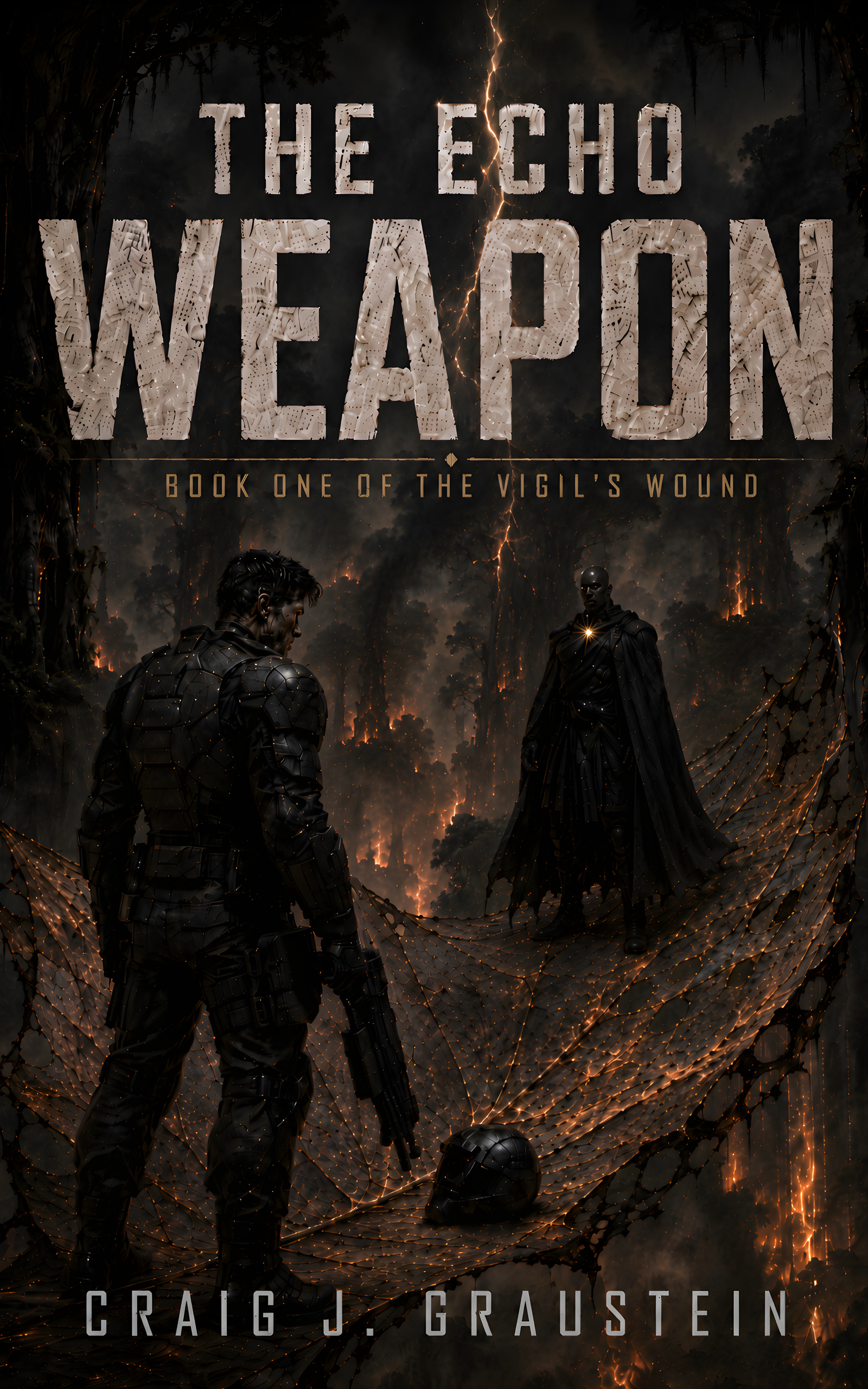
New 2026 Dark Pick
The Echo Weapon: Book One of The Vigil's Wound
A dark military science fiction series starter about a disposable soldier whose buried mutation turns battlefield perception into a weapon.
- dark military science fiction
- military space opera
- squad combat sci-fi
- super soldier science fiction
- genetic mutation science fiction
Cade Medeiros
Cade is the human pressure point of the series: a disposable Dominion cadet whose value changes faster than anyone around him can morally process. The important thing is that he is not special in the comforting chosen-one sense. He is special in the dangerous bureaucratic sense, where being unusual means someone will eventually invent a file category for you.
That is why his arc works for military SF and dark fantasy readers at the same time. Fantasy readers recognize the marked person. Military SF readers recognize the asset. The book's colder move is making both readings true enough to hurt.
The Echo
The Echo is Cade's awakened anomaly: battlefield perception, sequence-sense, alien inheritance, and weaponized intuition tangled together. It should not be read as a clean superpower. A clean superpower makes the hero more comfortable. The Echo makes Cade more effective and less private.
The best way to understand it is as a rival grammar inside the body. Cade experiences pressure before language catches up. Command will want to classify it. Enemies will want to mythologize it. Friends will want him to remain the same person after using it. None of those demands fit neatly together.
The Choral Vigil
The Vigil is the book's sacred wound: worshiped as god, used as infrastructure, and revealed in Chapter 1 as a mind with its own contempt, grief, strategy, and fear. This is the strongest image in the premise because it refuses to stay in one category. God, machine, prisoner, architect, liar, victim, parasite, wall.
That category instability is exactly the point. If the Dominion crosses space by burning pieces of a living intelligence, then travel itself has a moral smell. The book's cosmic scale begins there, not with a big map.
The Dominion
The Dominion is not only the government on the page. It is the logic that says order justifies use. It owns soldiers through training, bodies through classification, religion through the Vigil, and history through the stories it allows people to repeat.
This matters because Cade's problem is not simply that enemies want him. His own civilization has all the language it needs to turn him into property while calling the process protection, doctrine, research, faith, or necessity.
Tithe Reapers
The Tithe Reapers are Cade's squad and the book's human handhold. They keep the story from floating away into god-machine abstraction. Through them, cosmic events arrive as orders, injuries, jokes, fear, resentment, loyalty, and the miserable practical business of staying alive.
The name also does real tonal work. It sounds half-military, half-sacrificial. That is the book in miniature: soldiers treated like instruments inside a civilization that has learned to make death sound official.
Manysung
Manysung is the old alien register behind the mutation, the relic technology, and the Vigil's ancient catastrophe. The term works because it suggests plurality before the reader has a full explanation: many voices, many minds, many strands in a ruined chorus.
For readers, the useful thing is not to memorize the lore immediately. The useful thing is to notice what the word does whenever it appears. It pulls the story away from ordinary military escalation and toward inheritance, contamination, ancient design, and the possibility that humanity has been living inside someone else's failed plan.
Great Doom and Iron Cull
The Great Doom is the ancient rupture in the Vigil's memory: the event that broke the old chorus and left the surviving intelligence terrified of something outside ordinary human history. The Iron Cull is the human-scale atrocity that burns weakness out of civilization and helps forge the Dominion's brutal shape.
Together they give the setting two depths of violence. One belongs to extinct or near-extinct gods. One belongs to humanity's imperial self-making. The nasty implication is that the Dominion did not merely inherit horror; it learned from it.
Resonance tethers
The resonance tethers are the connective tissue between human travel, Manysung relics, and the Vigil's chained consciousness. They are not just technobabble. They are how the book makes infrastructure feel alive enough to suffer.
A good science-fiction term earns its place when it changes behavior. Here, resonance means fleets move, priests worship, command plans campaigns, and Cade's body may be connected to something older than the orders he receives.
Stillwatch and the deep dig
Stillwatch gives the sample its ground truth: cold, bad machinery, military boredom, and tunnels that do not look made by human tools. It is the kind of place military SF needs more often: not the glorious front, but the miserable post where routine is how terror disguises itself.
The deep dig matters because it lets weirdness enter through work. Tavian and the others are not wandering into mystery because prophecy called them. They are on shift. That is a more military and more convincing way to open a door into horror.
Attestor Mk.IV
The Attestor Mk.IV is a small but useful signal. A named rifle can be cheap flavor if the book only wants gear porn. Here it works better as a piece of soldier routine: Tavian checks the action, knows the lubricant will thicken, and measures danger through maintenance before anything dramatic happens.
That is the military texture readers ask for when they complain that a book has weapons but no soldiering. The tool matters because the conditions matter.
The Sanguinary
The Sanguinary pressure around forbidden technology gives the series its religious-danger flavor. The important thing is not just that the setting has zealots or holy language. The important thing is that belief can become operational. It can decide who gets hunted, dissected, protected, or erased.
That is why the book's religion is useful for both SF and fantasy readers. It is not just atmosphere. It competes with military classification for the right to define what Cade is.
Why the glossary matters
A glossary is not homework if it explains pressure instead of dumping nouns. The point is not to make readers memorize every faction before Chapter 2. The point is to show which words carry power: which ones name ownership, which ones name faith, which ones name old crimes, and which ones make Cade less safe.
That is also why the glossary belongs on all three sites. Science fiction readers get the system. Military SF readers get the institution. Fantasy readers get the cursed-power and chained-god translation.
Review-desk notes: the neighboring books matter
A stronger genre site should talk about The Expanse, Red Rising, Revelation Space, and Dune with respect, not use them as bait. On The Echo Weapon Glossary, the useful move is to explain what each neighboring book teaches about reader taste, then show where The Echo Weapon steps into that conversation with its own pressure: squad combat, alien infrastructure, empire, mutation, and the waking Vigil.
- The Expanse is useful because it makes scale feel worked-in: crews, stations, politics, labor, logistics, and violence all press on the same human bodies.
- Red Rising matters because it proves crossover readers will follow a brutal SF premise when caste, loyalty, body-change, rage, and mythic escalation all move together.
- Revelation Space belongs near the darker pages because it treats deep time and alien inheritance as pressure, not decoration.
- Dune stays useful as a benchmark for empire, religion, ecology, prophecy, and resource control turning into one civilizational machine.
What this page should make you notice in The Echo Weapon
The Echo Weapon gets stronger when the page treats its premise like a pressure system, not a jacket line. Humanity did not simply discover a strange old machine. It chained the last god, worshiped it as the Vigil, burned pieces of its ancient mind to cross the stars, and then built a Dominion that calls that dependency civilization.
- Cade is not interesting because he becomes special. He is interesting because the Echo makes him legible to institutions that already know how to spend people.
- The science-fiction idea has consequences at several scales: nerve, squad, academy, war economy, transit lattice, church language, and alien ruin.
- The Manysung material should feel like dead infrastructure with rules, not magic paint over a space-opera hallway.
- The best pages should make the reader feel the same question from different angles: what does a civilization become when its fastest road is a wounded god?
Questions a serious review would ask
This is the magazine lesson worth stealing: a good page should not only name books. It should teach the reader how to judge the promise. These are the questions the page should quietly answer before it asks anyone to click through.
- Does the central idea change bodies, institutions, travel, religion, and command decisions, or does it only decorate the pitch?
- Does the cosmic scale stay attached to people with names, wounds, responsibilities, and bad choices?
- Does the book let adjacent classics keep their dignity while still explaining what this newer series is trying to do differently?
- Does The Echo Weapon make the Vigil feel like civilization infrastructure and not just a monster waiting behind a curtain?
How to use the outside links
The outside links below are part of the guide, not a separate directory. Use them to verify named books and series, follow current genre conversation, compare the page against review outlets and podcasts, and see how readers discuss the same appetite in public communities.
Outside Reading, Reader Discussion, and Context
Related Guides
Read Next
Classic Review Guide
12 Fantasy Classics That Still Respect Readers
An opinionated fantasy classics guide for readers who care about gods, power, war bands, prophecy, dark empires, and crossover science fiction. These are not museum labels.
Sample Chapters
Read The Echo Weapon: Prologue and Chapter 1
The opening chapters of The Echo Weapon by Craig J. Graustein, with the Vigil prologue and the first ground-level military scene. The sample shows the book’s core move: god-scale horror above, frozen squad-level military pressure below.
Review Desk Q&A
The Echo Weapon Fantasy Crossover Desk Q&A
A fantasy-reader review-desk Q&A on The Echo Weapon, focused on the chained god, cursed-power feeling, empire pressure, Red Rising overlap, and why the book is still science fiction. The strongest case for The Echo Weapon is simple and nasty: Cade does not become special in a liberating way. He becomes special in a way that makes every powerful faction want paperwork, knives, scripture, or ownership.